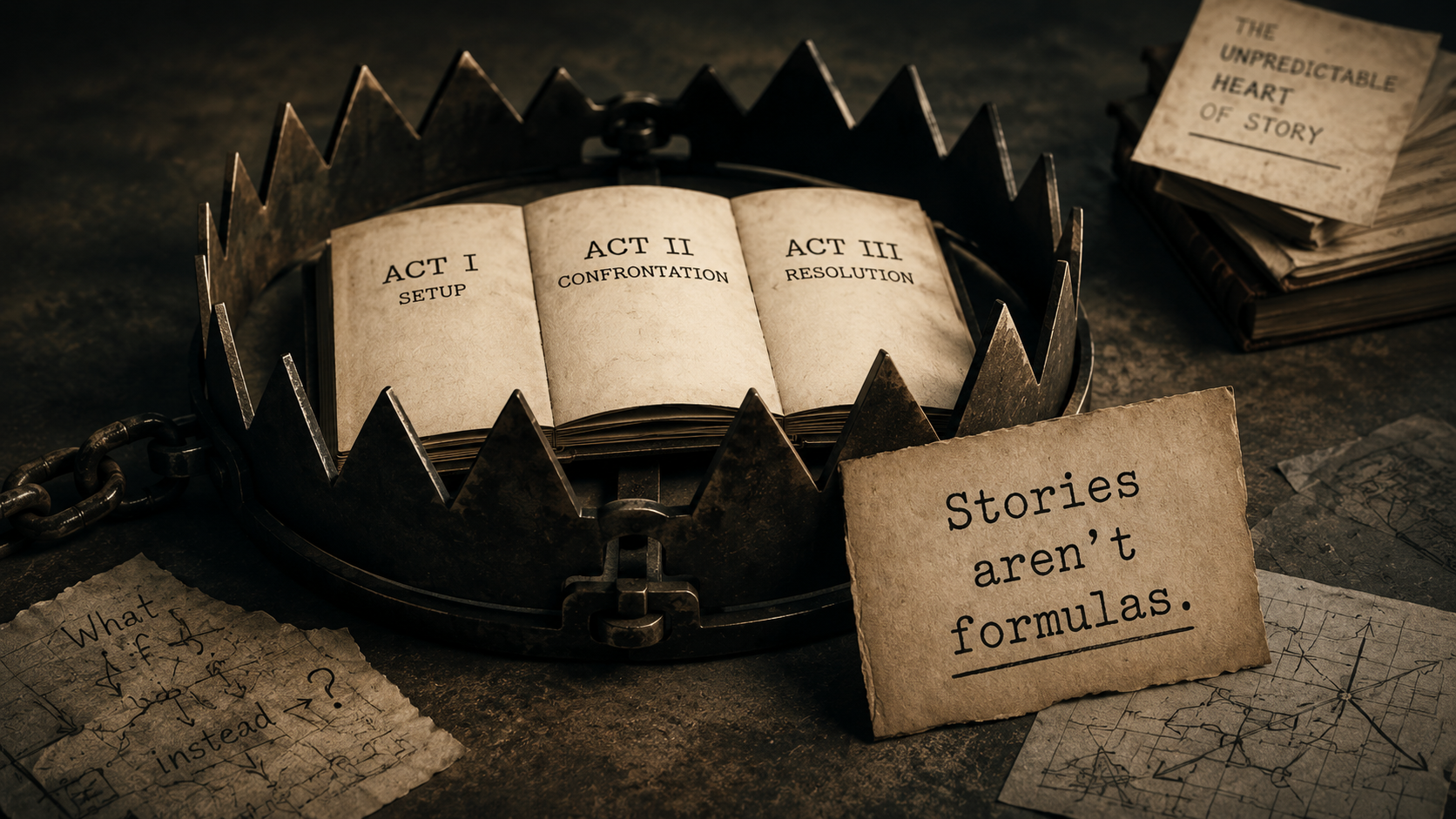
The three-act structure is everywhere. It is in every screenwriting textbook, every story seminar, every online course that promises to teach you how narrative works in twelve modules or fewer. Setup, confrontation, resolution. The inciting incident at page twelve. The midpoint reversal. The dark night of the soul. By now the framework is so thoroughly absorbed into our understanding of story that many writers cannot conceive of structure as anything else.
That is precisely the problem.
The three-act model is not wrong. It describes something real about how stories move. But a description is not a prescription, and when writers mistake a map of story for a recipe for story, they produce work that is architecturally correct and emotionally inert. The beats land where the manual says they should. The reader feels nothing.
What the Model Actually Describes
Aristotle's Poetics , the source everyone cites, usually without having read it , says that a tragedy must have a beginning, middle, and end. This is so obviously true as to be nearly meaningless. Every experience has a beginning, middle, and end. The observation says nothing about proportion, nothing about causality, nothing about the relationship between what a character wants and what they need.
What the three-act model actually describes is the shape of a particular kind of Hollywood film from a particular era: roughly the 1970s through the 1990s, when the format was refined and codified by producers and script consultants into a set of bankable conventions. It is not a universal law of storytelling. It is an industrial standard, like a shipping container , useful because it is standardized, limiting for the same reason.
"A description is not a prescription. When writers mistake a map of story for a recipe for story, they produce work that is architecturally correct and emotionally inert."
Novels have never obeyed it, not the ones worth reading. Tolstoy does not have a midpoint reversal in any recognizable sense. Woolf's novels have no inciting incident at page twelve. Nabokov builds structures that spiral inward rather than march forward. These are not failures of structure. They are evidence that structure has more than one shape.
The Alternative That Has Always Existed
The model hiding in novels since the mid-nineteenth century is not one model at all , it is a set of structural instincts that have more to do with pressure than with sequence. The question is not: where does the story turn? The question is: where does the pressure increase, and what does the character do when it becomes unbearable?
George Eliot understood this. Her novels do not have three acts. They have waves , accumulations of social pressure, moral obligation, and private desire that build and recede and build again, each cycle higher than the last. The plot is not a mechanism for delivering beats. It is an environment that the characters must survive or transform.
Pressure over sequence
When you think in terms of pressure rather than sequence, several things change. The inciting incident stops being a plot device and becomes a revelation , something that tells the reader what the character is actually made of before they know it themselves. The midpoint stops being a gear-shift and becomes a moment of false clarity, the point at which the character thinks they understand the situation and is wrong in the most instructive possible way.
Shape over formula
More importantly, the overall shape of the story becomes something you discover rather than something you impose. Not every story wants to resolve. Some want to accumulate. Some want to narrow. Some want to open outward at the end into something larger than what the plot seemed to promise. The three-act structure, followed faithfully, forecloses all of these possibilities in advance.
None of this means you should ignore structure. Structure is not optional , it is what keeps a story from collapsing under its own weight. But structure is a consequence of understanding what your particular story needs, not a template you fill in. The writers who produce the most alive fiction are not the ones who have mastered the rules. They are the ones who have understood them deeply enough to know when a different shape is required.
The three-act structure will tell you when to turn. It will not tell you what the turn should cost, or what it should mean, or whether a turn is even the right move. That part is still your job.