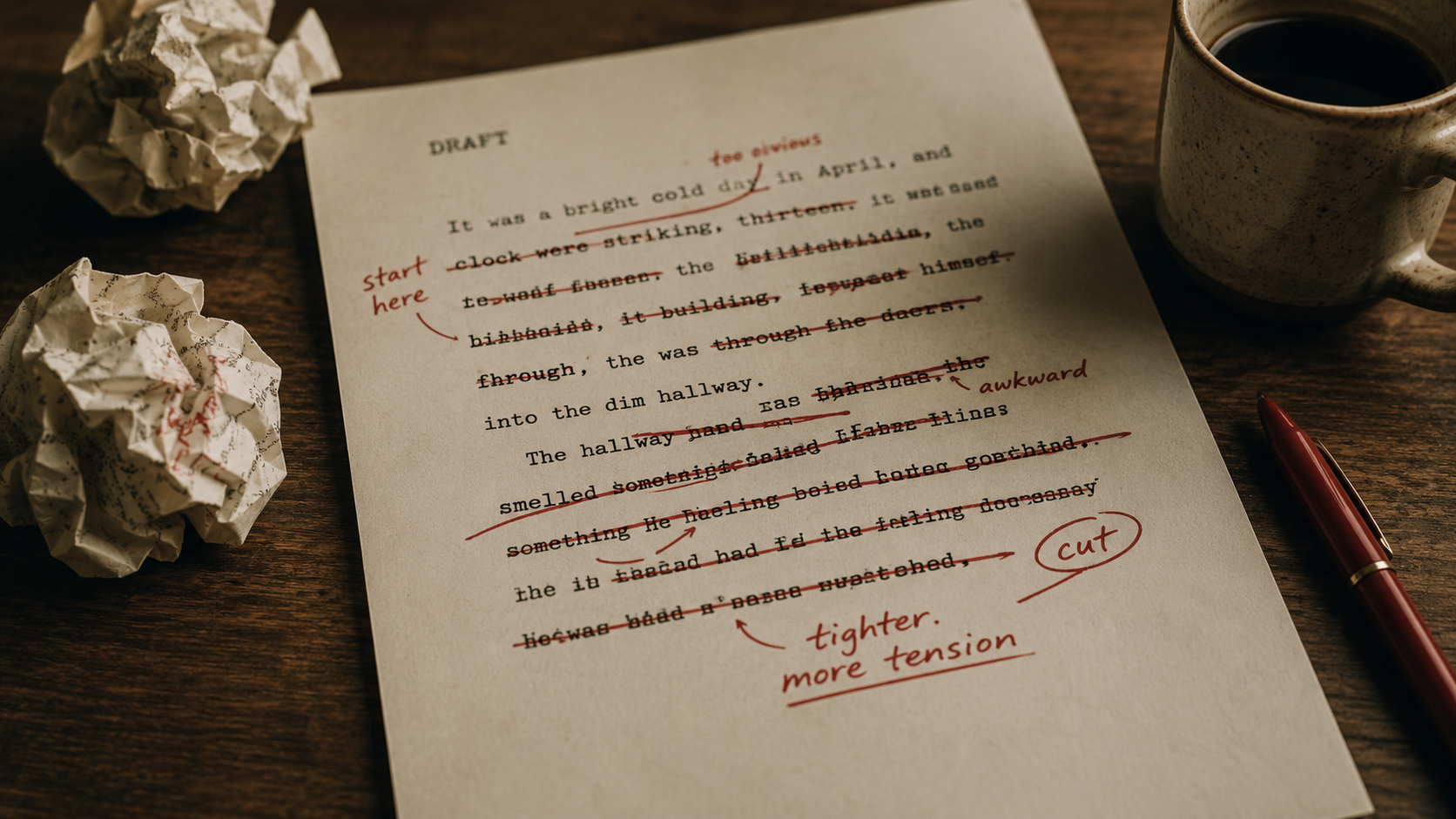
The advice has been attributed to Faulkner, to Chekhov, to Oscar Wilde, to Samuel Johnson, to Arthur Quiller-Couch, who almost certainly coined it and whom almost no one remembers. "Kill your darlings." It is the most repeated piece of writing advice in the English language, and it is, in the hands of the writers who take it most literally, also some of the most destructive.
The problem is not the advice. The problem is what writers hear when they receive it. They hear: if you love something you have written, that love is evidence against it. They hear: attachment is always sentimentality, and sentimentality is always a flaw. They take the scalpel to every sentence that gave them pleasure and leave behind a text that is technically defensible and completely airless.
This is a misreading. What the advice actually targets is not the sentence you love. It is the sentence that has earned your love for the wrong reasons.
Why You Love the Wrong Sentences
Writers love sentences for many reasons, and most of them are legitimate. You love a sentence because it says something true. You love it because it sounds exactly right, because the rhythm lands, because the image is precise and strange in the way only the right image can be. These are good reasons. Sentences that earn that love usually deserve to stay.
But some sentences earn your love through a different mechanism entirely. You love them because you worked hard to produce them. Because they represent a breakthrough after a long struggle. Because they arrived at two in the morning when you had almost given up, and finding them felt like a gift. The labor, the struggle, the relief , these are not properties of the sentence. They are properties of your experience writing it. And they are completely invisible to the reader.
"The darling you should kill is not the sentence you love. It is the sentence whose removal would improve the work, and which you are keeping only because you cannot bear to let it go."
The darling you should kill is not the sentence you love. It is the sentence whose removal would improve the work, and which you are keeping only because you cannot bear to let it go. These are different categories, and learning to tell them apart is one of the central skills of revision.
The Test
I use a simple test, though simple does not mean easy. Cover the sentence. Read the paragraph without it. Does the paragraph lose something that the reader would have noticed? Does the surrounding text become less clear, less vivid, less rhythmically coherent? If so, the sentence is earning its place and should stay.
When it needs to move, not die
Often what I find is that the sentence is genuinely good , it is doing real work, just not the work required by this particular moment in this particular piece. It belongs somewhere else: earlier, later, in a different essay entirely, or saved for a future piece that does not yet exist. A sentence that arrives too early or lingers too long is not a bad sentence. It is a misplaced one. The graveyard for these is not the delete key. It is a separate document where nothing is ever truly lost.
When it really does need to die
The sentences that truly need to go are almost always recognizable by a specific symptom: they call attention to themselves. The reader's eye pauses on them not because they are resonant but because they are conspicuous. They are performing. They are trying too hard, showing too much of the writer's effort, asking to be admired rather than simply doing their job. These sentences, no matter how much you love them, are a cost the work cannot afford.
Revision is not subtraction. It is a form of listening , paying attention to what the work actually is, rather than what you intended it to be. The darlings worth killing are the ones that stand between you and that honest accounting. Everything else, keep. Love is not the problem. Misplaced love is.
Save the file. Open a new document. Paste the sentence there. You did not kill it. You just stopped forcing it on a piece that had no room for it. That is not cruelty. That is craft.